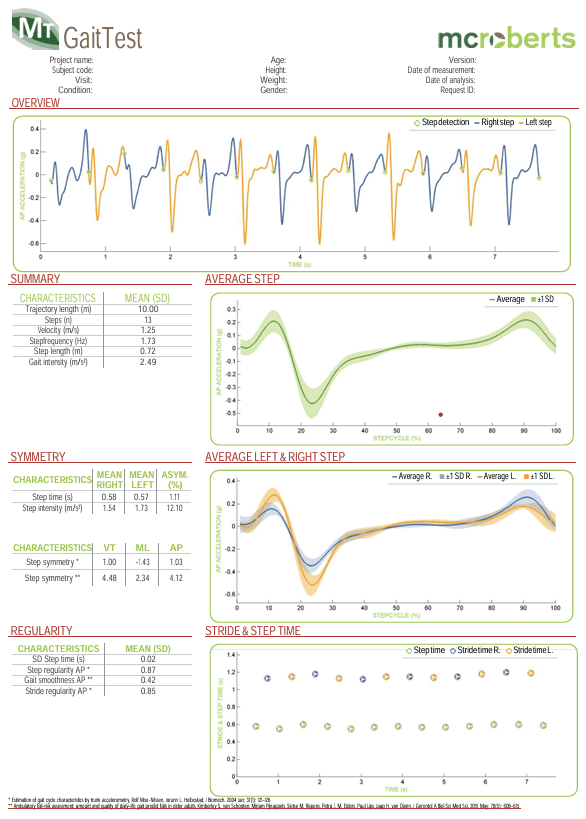
The GaitTest provides a detailed assessment of walking performance over a straight trajectory, capturing spatiotemporal gait parameters that are difficult to measure with traditional tools. Using the MoveTest, step characteristics, symmetry, and stability are quantified objectively and unobtrusively. Unlike motion-capture systems or pressure sensitive walkways, which are costly and confined to dedicated spaces, the GaitTest enables high-quality gait analysis in any clinical or research setting.
Key Outcomes
Walking Speed
Average walking speed over the full trajectory is calculated, providing a clear and clinically relevant indicator of overall gait performance.
Step Time
Temporal characteristics of gait are captured through step time and its variability, reflecting rhythm, coordination, and walking stability.
Step Length
Mean step length and its variability are reported, offering insight into spatial aspects of gait quality and movement control.
Step Symmetry
Left–right step differences are quantified to assess gait symmetry, an important marker for identifying asymmetric or compensatory walking patterns.
Gait Regularity
Stride-to-stride regularity metrics measure the consistency of the walking pattern, helping to detect gait instability or altered control strategies.
Gait Intensity
Acceleration-based measures of gait intensity reflect the dynamic quality and vigor of walking, distinguishing between light and more forceful gait patterns.
Resources
January, 2025
Concurrent Validity, Test-Retest Reliability, and Sensitivity to Change of a Single Body-Fixed Sensor for Gait Analysis during Rollator-Assisted Walking in Acute Geriatric Patients
August, 2020
Example Report