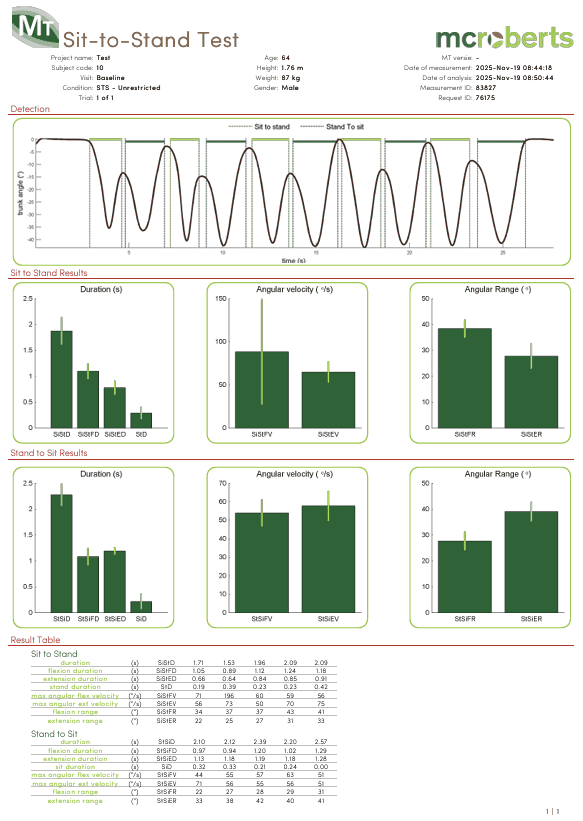
The Sit-to-Stand (STS) test evaluates a key aspect of daily mobility: the ability to rise from a chair. Traditionally, only the total time for repeated chair rises is measured, providing limited insight into performance quality. With the MoveTest, trunk kinematics, timing, and dynamics of the movement are captured in detail, offering a deeper understanding of how the transition is performed rather than just how fast.
Key Outcomes

Total Duration
The total duration of each Sit-to-Stand cycle, from rising to sitting down again, is automatically calculated to replace manual timing.
Sub Durations
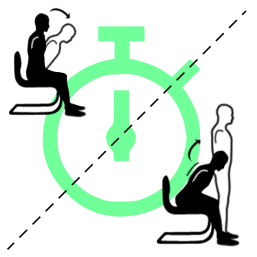
Dynamic phases (trunk flexion and extension) and static phases (fully seated and fully standing) are identified separately, providing detailed timing for each component of the movement.
Trunk Angles
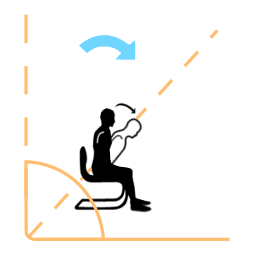
Trunk flexion and extension angles are calculated for both rising and sitting phases, offering insight into postural control during the transition.
Angular Velocity
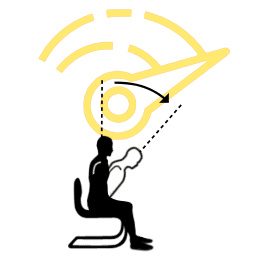
Trunk angular velocities during flexion and extension are quantified for each cycle, capturing rotational movement patterns throughout the transitions.
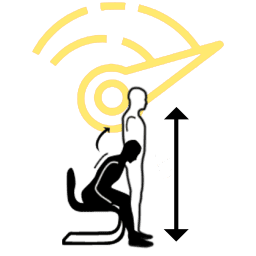
Vertical Velocity
Upward and downward velocities of the body’s vertical movement are derived for each rise and descent, reflecting the smoothness and vigor of the motion.

Power Generation
Estimated power output is calculated for both rising and sitting phases, providing an objective measure of strength and functional performance during the transition.
Resources
Association of real life postural transitions kinematics with fatigue in neurodegenerative and immune diseases
January, 2025
August, 2023
Abody-fixed-sensor-based analysis of stair ascent and sit-to-stand to detect age-related differences in leg-extensor power
January, 2019
Older Adults with Weaker Muscle Strength Stand up from a Sitting Position with More Dynamic Trunk Use
April, 2018
People with Dementia Can Learn Compensatory Movement Maneuvers for the Sit-to-Stand Task: A Randomized Controlled Trial
July, 2017
The Instrumented Sit-to-Stand Test (iSTS) Has Greater Clinical Relevance than the Manually Recorded Sit-to-Stand Test in Older Adults
July, 2016
July, 2014
Automated approach for quantifying the repeated sit-to-stand using one body fixed sensor in young and older adults
May, 2013
Validation of seat-off and seat-on in repeated sit-to-stand movements using a single-body-fixed sensor
October, 2012
Example Report