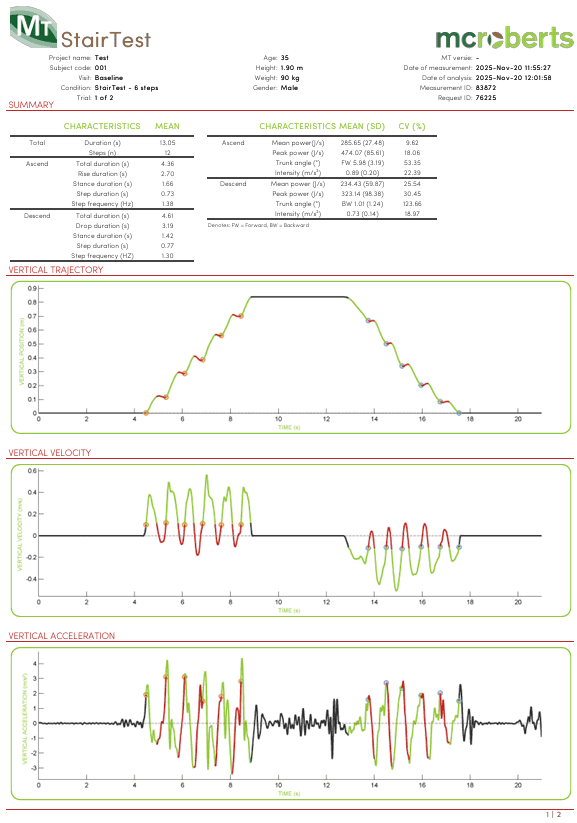
The StairTest provides an objective evaluation of stair ascent and descent—an essential component of daily mobility that is often challenging to measure accurately. Using the MoveTest, step cycles, timing, trunk kinematics, and movement dynamics are captured in detail for both directions. This enables clinicians and researchers to assess stair performance with greater precision than traditional stopwatch-based methods, and without the need for specialized lab equipment.
Key Outcomes
Total Duration
The total time required to ascend and descend the staircase is automatically calculated, replacing stopwatch-based timing with an objective and reliable measure.
Steps
The total number of steps taken during ascent and descent is detected and reported, providing a clear overview of step count and rhythm throughout the task.
Sub Durations
Durations of key phases—rise and stance cycles for both ascent and descent—are identified separately, offering detailed insight into movement control across the stair negotiation process.
Step Frequency
Step frequency (Hz) is calculated for ascent and descent, reflecting cadence and the overall tempo of stair climbing and descending.
Trunk Angle
Trunk flexion and extension angles are derived for each step cycle, providing information on postural strategy and control during both upward and downward movement.
Power Generation
Power output during ascent and descent is estimated from sensor-derived movement dynamics, offering an objective measure of functional strength during stair negotiation.
Resources
Stair-Climbing Versus Machine-Based Resistance Exercise to Improve Muscle Power Among Older Adults: A Noninferiority Trial
March, 2025
Minimal power required to ascend a flight of stairs versus actual power measured with body-fixed sensors in adults aged 19-85 years
March, 2024
Older adults’ lower-limb muscle power production throughout a full flight of stairs: Reliability and comparison between different stair models
February, 2024
Recreational Football Training Increases Leg-Extensor Velocity Production in 55- To 70-Year Old Adults: A Randomized Controlled Trial
A body-fixed-sensor-based analysis of stair ascent and sit-to-stand to detect age-related differences in leg-extensor power
Example Report